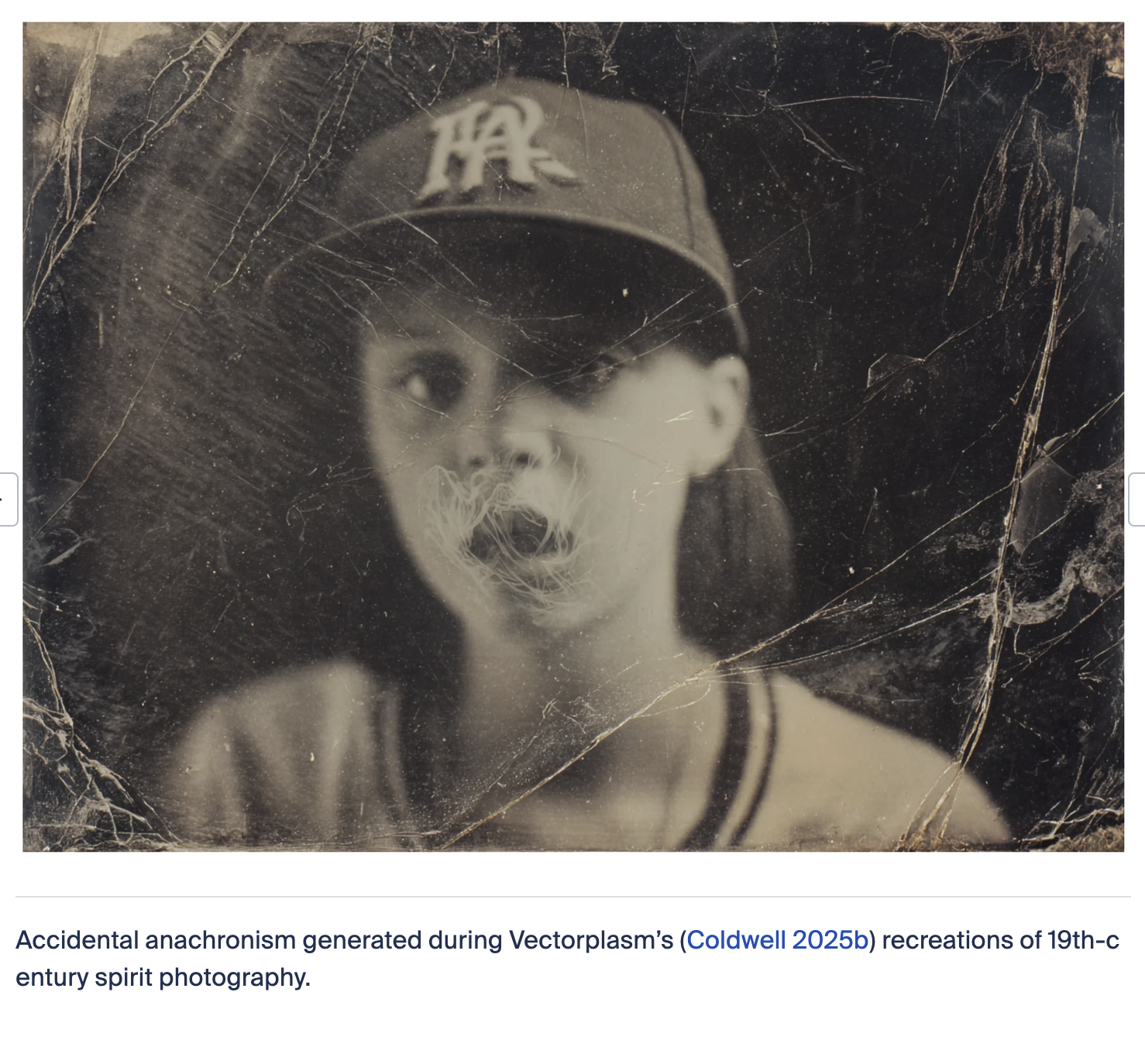
The journal article argues that generative AI is not just a new visual medium, but an entirely new kind of “substance”
My article “Vectorplasm: The Weird and Haunted Material Underlying AI Images” has now been published in a Special Issue of Humanities journal entitled Media, Cultural Memory and Hauntology, edited by Dr. Keith McDonald & Prof. Dr. Robert Edgar
https://www.mdpi.com/2076-0787/15/12/178
After many years investigating the spectrality of photography through creative practice research, several new multimodal projects, conducted between 2022 and 2025, attempted to see if the hauntological theory I had developed translated to the virtual images we find in contemporary generative AI production. While this new medium did seem to be haunted by photography and other prior media, in manifold ways, it quickly became apparent that something very different was happening to these technological ghosts, something truly transformative. This paper proposes a new way of thinking about spectrality and AI together. “Vectorplasm”: or virtual/vector-based “ectoplasm”—is a neologism derived from Roland Barthes’ use of the word in seminal photography theory (Camera Lucida). Vectorplasm is a digital miasma from which new ghosts appear or are constructed. Vectorplasm is the raw material of generative AI. It consists of stored vectors, random noise and a language model, working together to summon new visual outputs from learned patterns and pareidolia, such as we see in denoising diffusion (e.g., Midjourney/Stable Diffusion). Strangely, this method of reproduction mirrors one of the more mysterious parts of human consciousness, as pareidolia is a key factor in human hallucination and the most common scientific explanation for ghost sightings. It’s the mechanism behind the human propensity for seeing faces that aren’t there. In generative AI, spectral photographic traces and information from the past are garbled and reformed into new mutant simulacra—“hallucinated” out of Vectorplasm. We only become aware of Vectorplasm’s underlying spectrality when we encounter the uncanny, glitches, or other unexplained phenomena in its outputs. In both The Jettison (2024) and /imagine Ronsack (2024), these weird and eerie errors were chased by the researchers to try and discover more about this haunted new ‘substance.’ Vectorplasm isn’t an ontological category, or any easily identifiable part of a given generative system, but instead, it can be seen as an emergent and hauntological symptom of the way such systems behave as a whole.